
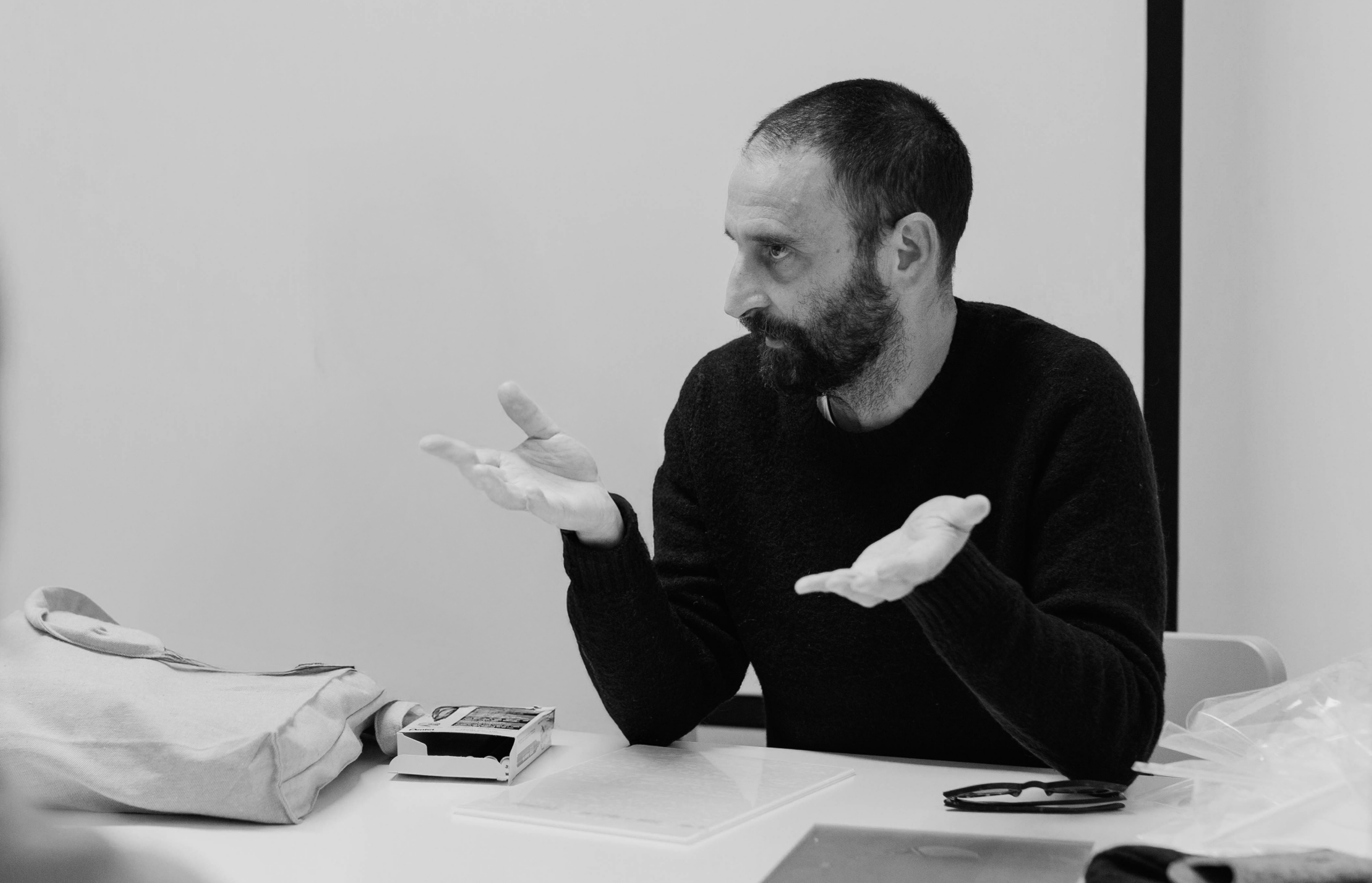
D: Matteo, before we get to the heart of the project: who are you as an artist and as a person today? How would you tell your story and what drives you to explore through art?
M: I believe I am, quite simply, the sum of all the experiences I have had and especially the ones I haven’t had, but which I still long for in some way. I don’t separate the person from the artist. They coexist, through ups and downs, through difficulties and moderate states of happiness, but they are together. Before becoming an artist, I had a fairly long period of corporate work, which led me to the decision to dedicate myself exclusively to art. The reasons for this choice are very complex and they are a very intimate part of my life that I don’t like to share publicly. That’s where my works live.
D: Your practice moves between different languages and always with particular attention to the ambiguity of meaning. If you had to summarize your poetics today, which guiding principle do you recognize as constant and which do you feel is evolving?
M: The core of my journey is certainly the relationship I seek with the audience, and the work is the tool I use to connect with others. My goal has always been to remove the superfluous to create objects (the works) that are as impactful and inclusive as possible. What is really important to me is being able to attract people with simple (not commonplace) languages, then push them in different directions that are often opposite to the initial meaning. Sometimes I succeed, sometimes I don’t. When this happens, the viewer forgets the starting point. That makes the work a success.
D: Over the years, you’ve built a recognizable artistic vocabulary. What are the cultural, biographical or visual roots that have shaped this sensibility in your way of looking at the world? Is there anything about this journey that still surprises you today?
M: If I didn’t surprise myself, I probably wouldn’t continue doing this work. What happens, in my case, is that I never know where I’m going or what I’m looking for. The idea simply comes to me and I embrace it. The only certain thing is that I’ll need to keep doing it. With patience and accepting all the failures that naturally come along. Someone said a while ago that the only way to discover the limits of what is possible is to go a little beyond them into the impossible. Maybe that’s what I’m trying to do. As I’ve said, I’m the sum of everything, of readings, travels, films, works (especially others’ work), people I’ve met... I can’t clearly separate the influences.
D: Your research is permeated by language, paradox and a form of irony that often reveals doubt where there seemed to be certainty. How does this project — which asks you to listen rather than speak — fit into your understanding of the artistic act?
M: I let myself be embraced by the idea. I welcome it. I modify it, shape it, and the result is the work. Of course, in doing so, I translate it through my experience and, in some ways, ruin it, but that’s how it is. Doubt is fundamental. My works are never truths. It’s an aspect of dialogue that interests me little. What I find stimulating, however, is precisely the short circuit that can be created by moving a comma, adding an accent. Micro-variations that, in a cascade, generate major changes in meaning. This, however, can also be achieved without the use of words, and, to be honest, the works I’m most fond of perhaps don’t contain any at all.
D: The project questions the border as a symbolic and concrete place, as a fragile threshold between identity and otherness, between memory and future. How would you define your personal perception of the border today, both in life and in your artistic practice?
M: For me, a border is not a limit, it is not precise. It is not a straight line that cuts or separates something. I experience it more as an open space, a place of dialogue. A possibility where the other and the self coexist. Each are generators of life in their own way. The past survives in the present but also, or above all, the future (certainly not as fate, but as expectation and motivation). The works are not just a snapshot of an idea, but its point of arrival and departure.
D: Is there a memory, an image, a moment that for you symbolically embodies the concept of the border and that, in some way, also recurs in this work?
M: A hug.
D: Participatory art brings with itself ethical, aesthetic and relational complexities. How did you negotiate the distance between your role as an artist and the need to welcome the words, fragilities and stories offered to you in dialogue with participating groups?
M: There was no distance, nor even complexity (in the negative sense). I’d rather say an extraordinary complicity. As the Argentinian poet said, “Our nothingness differs little; it is a trivial and chance circumstance that you should be the reader of these exercises and I their author.” I embraced this many years ago, and I’ve always positioned myself as a beneficiary of the experience I enact, even when I’m the creator. Certainly, in this case, as in others, I didn’t shirk the responsibility of being the artist asking for participation, but I left maximum freedom to each individual’s will.
D: In engaging with the participants, you experienced a wide range of emotions, silences, memories and vulnerabilities. Was there a moment, a gesture or a word that touched you more deeply and changed the way you listened or artistically returned what you received?
M: I wouldn’t want to highlight any specific moment, because that would automatically exclude others. Every movement, every moment was formative, just as the spaces between words determine the power of the words themselves. After all, this experience was mainly about listening and acceptance, without any kind of judgment. Every word given, every drawing expressed was a gift. I simply put them together.
D: Translating a plurality of voices into a public installation means selecting, subtracting, composing. How did you transform this heterogeneity into a simple visual form that is also imbued with meaning?
M: Actually, the work was done before the meetings. We decided together with the association QUI ALTROVE how to structure the work and the installation, while leaving its development and content completely open. In fact, we prepared a blank palette on which each participant would create their own intervention. Transforming the plurality of interventions into a single body was very simple because we avoided any judgment (both aesthetic and conceptual). This greatly simplified the composition of the elements. The work thrives on the strength of each participant.
D: The venue hosting the restitution, The Circle, is not a neutral container but a space with its own energy, history and intention. How did this location influence — if it did — your project? What kind of dialogue was established between the space, the association and the conceptual material collected by the groups?
M: Space always influences an exhibition project. It becomes an integral element indeed. In this specific case I identified, from the outset, the different areas of the gallery that would house the three installations, leaving the central core completely free. The choice to use plexiglass to accommodate the drawings (which very often turned out to be sentences) was driven by the desire to be able to use them later in a reflective manner. Continuously displaying words on the monitor is a practice I’ve been using for a long time and perfectly embraces the idea of not judging them in any way.
D: What kind of experience would you like to generate in the audience? A crossing, a suspension, a question? What do you hope will happen, even if only for an instant, in those who encounter the work and visit the exhibition?
M: While the audience is always at the center of my creative endeavors, I never worry about guiding its reaction. What I do is entrust it with my work so that, in some way, it can complete it through its enjoyment or even its mere presence. Of course, reactions to the work will vary, and it’s pointless to try to predict them all. “A crossing, a suspension and a question” would already be an extraordinary achievement.
D: What does this shared process leave you with — as an artist and as a person? How do you think it might influence your future research?
M: I believe I’ll discover the power and purpose of this experience over time. It’s certainly been full of unexpected encounters, surprises, difficulties and so many other things that I simply can’t describe now. It’s a building block that adds to the others and contributes to making me who I am and who I will be. I carry people’s views, their desires (expressed in drawings and words, or simply silences) with me, I cherish and treasure them.